Assuming it is the 42RLE automatic you are referring to, I'm sure you could hotwire something to lock up the converter. That said, you may run into a stalling issue.
Be sure to use 4Low whenever needed. Even unlocked, the transmission and torque converter will provide significantly better engine braking in 4Low than in 4Hi.
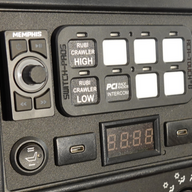
If even that isn't enough, one common solution is the Rubicrawler, which is a secondary selectable gear reduction that can be added to the 42RLE. It functions sort of like an extra transfer case gear reduction and will make the engine braking significantly tighter than just 4Low alone.
I definitely need to do some trial and error experimentation to see if I can get some actual engine braking out of it in 4 low.
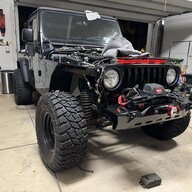
While I'm planning on 5.38s, I'll be running big tires, and with the 3.73s and 33s this thing feels like a race car in low. A rubi swap (potentially JK?), RubiCrawler, and Atlas are options being explored.
I'm cautious about monkeying with the TCM (PCM?) circuitry with all the issues the module can create, but I'll at least start exploring a lockup switch option.
Circuit dump for now:
TCCS is a bad diagram per hear, removed.
TCC Solenoid seems to be missing from the trans diagram, although it seems it may be a function of the Low/Reverse solenoid circuit:
TORQUE CONVERTER CLUTCH (TCC)
Fig. 248 Torque Converter Clutch (TCC)
Open In New Tab Zoom/Printimage
The TCC (Fig. 248) was installed to improve the efficiency of the torque converter that is lost to the slippage of the fluid coupling. Although the fluid coupling provides smooth, shock-free power transfer, it is natural for all fluid couplings to slip. If the impeller (3) and turbine (5) were mechanically locked together, a zero slippage condition could be obtained. A hydraulic piston (6) with friction material (7) was added to the turbine assembly (5) to provide this mechanical lock-up.
In order to reduce heat build-up in the transmission and buffer the powertrain against torsional vibrations, the TCM can duty cycle the L/R-CC Solenoid to achieve a smooth application of the torque converter clutch. This function, referred to as Electronically Modulated Converter Clutch (EMCC) can occur at various times depending on the following variables:
- Shift lever position
- Current gear range
- Transmission fluid temperature
- Engine coolant temperature
- Input speed
- Throttle angle
- Engine speed