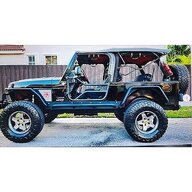
Jeep Wrangler TJ Hard Top Repairs

For most of my fiberglass projects I start with a layer of 3/4 oz. mat followed usually by two layers of 1 1/2 oz. mat. I apply the resin with a brush and then push the resin into the mat with either the same brush or sometimes with a brush with the bristles cut short to make it stiffer when used with a stippling/poking action.

Also sometimes bubbles exist because there isn't enough resin saturating the mat so make sure you're using enough resin. Don't go overboard with that though, parts made with too much resin to fiberglass ratio often will be brittle.

i forgot to ask this question in my last post. This hard top is basically white under the black paint so I’m curious when these tops were all made were they sprayed in a gel coat because patching them never looks the same or were they able to use a white colored resin during the process?

Something else I’ve realized fixing this crack is if I should sand the entire top or is there a way to add the texture back to it like original paint?
Thanks
 
i forgot to ask this question in my last post. This hard top is basically white under the black paint so I’m curious when these tops were all made were they sprayed in a gel coat because patching them never looks the same or were they able to use a white colored resin during the process?

All of the factory hardtops I have worked on have the panels molded with white tinted resin. This is a JKU Freedom panel, if you check the cracked edges you can see they're white all the way through. BTW I was able to repair this damaged panel and return it to use.

FreedomPanelDamage2.jpg


This next photo is a different JK Freedom panel, note as I sand the exterior surface, it's white below the paint.

RoofRepair3.jpg


The interior panels are molded in white but not painted. The black exterior is painted.

Something else I’ve realized fixing this crack is if I should sand the entire top or is there a way to add the texture back to it like original paint?
Thanks

This is the same damaged Freedom panel as the one in the second photo above; the texture is a pretty good match. I achieved this with MOPAR rattle can hardtop touchup paint, holding the can much further than normal from the surface - at that distance the droplets of paint seem to come together into larger droplets before hitting the surface, resulting in a texture that's a fairly good match. Might take a little practice to get it right, but it can be done.

RoofRepair8.jpg
 
All of the factory hardtops I have worked on have the panels molded with white tinted resin. This is a JKU Freedom panel, if you check the cracked edges you can see they're white all the way through. BTW I was able to repair this damaged panel and return it to use.

View attachment 631731

This next photo is a different JK Freedom panel, note as I sand the exterior surface, it's white below the paint.

View attachment 631729

The interior panels are molded in white but not painted. The black exterior is painted.


This is the same damaged Freedom panel as the one in the second photo above; the texture is a pretty good match. I achieved this with MOPAR rattle can hardtop touchup paint, holding the can much further than normal from the surface - at that distance the droplets of paint seem to come together into larger droplets before hitting the surface, resulting in a texture that's a fairly good match. Might take a little practice to get it right, but it can be done.

View attachment 631730

Pretty amazing I had no idea rattle can could come out this nice. Did you use a primer before you sprayed the color?
I’m starting to like the challenge of fiberglass work.
 
Pretty amazing I had no idea rattle can could come out this nice. Did you use a primer before you sprayed the color?
I’m starting to like the challenge of fiberglass work.

Yes. Can't recall exactly what I used but probably rattle can Krylon for a small repair like this.

Before primer:

RoofRepair6.jpg


After:

RoofRepair7.jpg


Fiberglass isn't as hard as people think it might be. The hard part is when you make original parts, or when you make new sections to replace broken or missing sections (like the first Freedom Panel I posted today - I needed to make several new sections to replace broken/missing sections and they had to be faithful to the original so the repaired Freedom Panels would work properly. When making new sections or completely new parts you need to make the mold masters and then the molds and these need to be made accurately so the final parts will fit properly and the masters/molds have to be finished well so the final parts are usable without lots of bodywork to perfect them. But repairs are a great place to start and usually not nearly as difficult as people think they would be.
 
Yes. Can't recall exactly what I used but probably rattle can Krylon for a small repair like this.

Before primer:

View attachment 631788

After:

View attachment 631787

Fiberglass isn't as hard as people think it might be. The hard part is when you make original parts, or when you make new sections to replace broken or missing sections (like the first Freedom Panel I posted today - I needed to make several new sections to replace broken/missing sections and they had to be faithful to the original so the repaired Freedom Panels would work properly. When making new sections or completely new parts you need to make the mold masters and then the molds and these need to be made accurately so the final parts will fit properly and the masters/molds have to be finished well so the final parts are usable without lots of bodywork to perfect them. But repairs are a great place to start and usually not nearly as difficult as people think they would be.

I’m sure the molds have to be dead on so it’s a little less work for you in the long run. What brand bondo do you recommend I use? I’m sure I will need some.
 
I’m sure the molds have to be dead on so it’s a little less work for you in the long run. What brand bondo do you recommend I use? I’m sure I will need some.

Any body filler that's rated as SMC-compatible should be fine - Wrangler hardtops are made from a variant of fiberglass called SMC (sheet molding compound), which includes a mold release component and because of that ordinary body filler doesn't bond very well to it; SMC-compatible fillers and resins have an additive to enable them to bond to SMC.
 
  • Like
Reactions: ChrisTJ98
Any body filler that's rated as SMC-compatible should be fine - Wrangler hardtops are made from a variant of fiberglass called SMC (sheet molding compound), which includes a mold release component and because of that ordinary body filler doesn't bond very well to it; SMC-compatible fillers and resins have an additive to enable them to bond to SMC.

Thank you, I picked up some 1.5 ounce chop mat and that helped a lot. I’m a bit concerned if I’m Sanding too much and taking away the strength of the repair. How does this look?

So many fillers out there, USC smc/fiberglass filler I found which I may go ahead and give it a try. It’s a lot cheaper than the evercoat stuff and hopefully works the same. I’m reading then people are saying to use a glaze which I assume is a finer filler then primer and paint is my guess. I don’t see how a glaze is needed not for this hardtop anyway.

IMG_9091.jpeg


IMG_9090.jpeg
 
Last edited:
Any body filler that's rated as SMC-compatible should be fine - Wrangler hardtops are made from a variant of fiberglass called SMC (sheet molding compound), which includes a mold release component and because of that ordinary body filler doesn't bond very well to it; SMC-compatible fillers and resins have an additive to enable them to bond to SMC.

What grit sand paper do you recommend I should sand the top to repaint it? I’ve decide I want to remove all of the texture that was from the factory. With your tips the fiberglass repair has come out looking way better than I ever thought.
Thanks
 
  • Like
Reactions: speeding_infraction
What grit sand paper do you recommend I should sand the top to repaint it? I’ve decide I want to remove all of the texture that was from the factory. With your tips the fiberglass repair has come out looking way better than I ever thought.
Thanks

The paint prep depends on the finish you're going for. Here are three examples, from quick and easy to automotive grade:

I built this half cab hardtop by modifying a CJ full top. I wanted a textured finish, which wouldn't require extreme sanding, so I think I went with 120 grit for the final sand. I then applied Rustoleum with a roller to achieve a nice texture. I don't recommend using Rustolem for a long-lasting finish, you'd probably need to repaint it every few years to keep it looking nice, but it didn't require extreme prep or lots of coats to result in a nice finish. A roller is a nice way to get a texture though, I think I used a 1/4" nap roller for a fairly fine texture. A foam roller would provide an even finer texture.

DSC_5746.JPG


For my JKU Safari Cab, after sanding the fiberglass with 120 grit, I applied 2k high-build primer and sanded that with 180 grit. I then applied Spice color automotive paint, followed by Eastwood's 2k matte clear. The matte finish is slightly textured and looks great.

FinalRoof2.jpg


FinalWashed2.jpg


For my LJ Safari Cab, I wanted a gloss finish so that hardtop looked the same as the body sheet metal. In this case I sanded the fiberglass with 120, then applied 2k high build primer and sanded that with 240. I then applied several coats of black automotive paint, followed by several coats of 2k gloss clear. When the clear hardened, I buffed it with fine buffing compound, resulting in a finish that unfortunately was actually better than the factory paint on the LJ's tub.

High build on the roof:

RoofHighBuild.jpg


The final color coat:

RoofColorCoat.jpg


Clear coat done, you can see the difference between this and just the black with no clear above:

RoofClearCoat4.jpg


I used the same process for the fiberglass CJ-style front clip I built.

LJ-8Final7.jpg


LJ-8Final3.jpg
 
The paint prep depends on the finish you're going for. Here are three examples, from quick and easy to automotive grade:

I built this half cab hardtop by modifying a CJ full top. I wanted a textured finish, which wouldn't require extreme sanding, so I think I went with 120 grit for the final sand. I then applied Rustoleum with a roller to achieve a nice texture. I don't recommend using Rustolem for a long-lasting finish, you'd probably need to repaint it every few years to keep it looking nice, but it didn't require extreme prep or lots of coats to result in a nice finish. A roller is a nice way to get a texture though, I think I used a 1/4" nap roller for a fairly fine texture. A foam roller would provide an even finer texture.

View attachment 641352

For my JKU Safari Cab, after sanding the fiberglass with 120 grit, I applied 2k high-build primer and sanded that with 180 grit. I then applied Spice color automotive paint, followed by Eastwood's 2k matte clear. The matte finish is slightly textured and looks great.

View attachment 641354

View attachment 641357

For my LJ Safari Cab, I wanted a gloss finish so that hardtop looked the same as the body sheet metal. In this case I sanded the fiberglass with 120, then applied 2k high build primer and sanded that with 240. I then applied several coats of black automotive paint, followed by several coats of 2k gloss clear. When the clear hardened, I buffed it with fine buffing compound, resulting in a finish that unfortunately was actually better than the factory paint on the LJ's tub.

High build on the roof:

View attachment 641360

The final color coat:

View attachment 641362

Clear coat done, you can see the difference between this and just the black with no clear above:

View attachment 641363

I used the same process for the fiberglass CJ-style front clip I built.

View attachment 641364

View attachment 641365

I started sanding yesterday from advice someone told which was 180-400 but I only had 120 and 320 at home and am sanding the texture/bumps away. I started to wonder if the factory use a texture in the paint to hide any discrepancies in the top or were they going for a certain look. Just watched a video of someone rolling like what you have done it looks great with a little texture. I really would like to make it last another 10+ years if possible? My thought was to spray it maybe a matte black color but now wondering maybe i should roll it like you have done. Lack of experience with spraying may not look as good as I would like. Could I use a foam roller and roll a high quality automotive paint and get a good 10 years out of it or no? I don’t know if only certain paints should be sprayed only and not rolled? The jk tan hard top after you primed it did you spray the tan color or did you roll it?
 
Last edited:
I started sanding yesterday from advice someone told which was 180-400 but I only had 120 and 320 at home and am sanding the texture/bumps away. I started to wonder if the factory use a texture in the paint to hide any discrepancies in the top or were they going for a certain look. Just watched a video of someone rolling like what you have done it looks great with a little texture. I really would like to make it last another 10+ years if possible? My thought was to spray it maybe a matte black color but now wondering maybe i should roll it like you have done. Lack of experience with spraying may not look as good as I would like. Could I use a foam roller and roll a high quality automotive paint and get a good 10 years out of it or no? I don’t know if only certain paints should be sprayed only and not rolled? The jk tan hard top after you primed it did you spray the tan color or did you roll it?

If you want to do a roller application and have it last 10 years, I recommend a marine topside paint such as Petit EZ-Poxy. It's a one-part polyurethane designed to be applied with a brush, spray or roller. It contains UV filter additives for long life outdoors. It's a gloss finish, but a satin modifier additive is available. Some of these marine paints have particular primer requirements for application on fiberglass so you'll need to check that out. One source is West Marine, if there's a store near you they can answer any questions you might have. https://www.westmarine.com/pettit-paint-ez-poxy-modern-polyurethane-topside-paint-249466.html

PetitEZPoxy.jpg
 
  • Like
Reactions: ChrisTJ98
If you want to do a roller application and have it last 10 years, I recommend a marine topside paint such as Petit EZ-Poxy. It's a one-part polyurethane designed to be applied with a brush, spray or roller. It contains UV filter additives for long life outdoors. It's a gloss finish, but a satin modifier additive is available. Some of these marine paints have particular primer requirements for application on fiberglass so you'll need to check that out. One source is West Marine, if there's a store near you they can answer any questions you might have. https://www.westmarine.com/pettit-paint-ez-poxy-modern-polyurethane-topside-paint-249466.html

View attachment 641607

Thanks, I had read about polyurethane primers should be used on SMC so this sound quite compatible then. A satin modifier does that take out some of the glossy look to it?
Yes I do have a west marine near me, I’ll get to reading on it. Thanks
 
Last edited:
If you want to do a roller application and have it last 10 years, I recommend a marine topside paint such as Petit EZ-Poxy. It's a one-part polyurethane designed to be applied with a brush, spray or roller. It contains UV filter additives for long life outdoors. It's a gloss finish, but a satin modifier additive is available. Some of these marine paints have particular primer requirements for application on fiberglass so you'll need to check that out. One source is West Marine, if there's a store near you they can answer any questions you might have. https://www.westmarine.com/pettit-paint-ez-poxy-modern-polyurethane-topside-paint-249466.html

View attachment 641607

You mention about a high build primer on one of the top restorations you did. Does high build mean when you spray it that it sprays on thick?
 
You mention about a high build primer on one of the top restorations you did. Does high build mean when you spray it that it sprays on thick?

Thicker than normal paint, but not really all that thick. It's intended to fill very minor sanding scratches from prior sanding, it's not thick enough to fill any damage to a panel - damage needs to be filled/sanded before high build is applied. Typically bodywork is done and block sanded with up to 400 grit just on the body filler, then epoxy primer is used to seal everything and after that (epoxy primer generally isn't sanded), high build will be sprayed on and final sanded with 400 or finer. High build sands very fine, the dust from it is like talcum powder and it's meant to be a final layer to perfect the smoothness of the panel rather than as a filler to fix visible flaws. If a flaw is still visible, it's probably too deep to be fixed with high build, high build is for final surface perfection before the final finish.
 
Thicker than normal paint, but not really all that thick. It's intended to fill very minor sanding scratches from prior sanding, it's not thick enough to fill any damage to a panel - damage needs to be filled/sanded before high build is applied. Typically bodywork is done and block sanded with up to 400 grit just on the body filler, then epoxy primer is used to seal everything and after that (epoxy primer generally isn't sanded), high build will be sprayed on and final sanded with 400 or finer. High build sands very fine, the dust from it is like talcum powder and it's meant to be a final layer to perfect the smoothness of the panel rather than as a filler to fix visible flaws. If a flaw is still visible, it's probably too deep to be fixed with high build, high build is for final surface perfection before the final finish.

Thank you for explaining that was much better than google, I read something about for SMC tops that polyurethane primer needs to be used so it will stick to it, this was google but google isn’t always true. Is this true?
 
Thank you for explaining that was much better than google, I read something about for SMC tops that polyurethane primer needs to be used so it will stick to it, this was google but google isn’t always true. Is this true?

I use 2-part epoxy primer as a first coat for everything. Sticks fine to SMC, fiberglass, metal.
 
  • Like
Reactions: ChrisTJ98