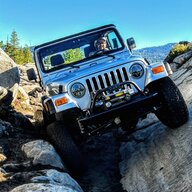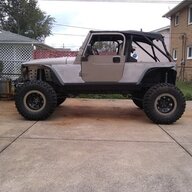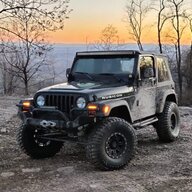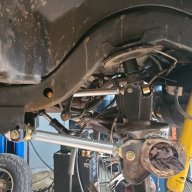
Dave Kishpaugh's (Jeep West) geometry correction brackets are now available

Status
Not open for further replies.
My mid arm went on almost a year before I did the rear outboard. There were no other changes at that time. Again the differences on pavement were miniscule. I daily drove this setup all around Colorado with about a 3.5" spring lift, the old style OME shocks and an Antirock.

If my Jeep was somehow unusually unstable after, then it was unusually unstable before. Which it wasn't.

I knew after the rear outboard and the tune I happened upon that there was something special there that I needed to continue to pursue. I won't go into the full details, except that I began to recognize the extent that shocks were able to define the ride quality and control the movements of the vehicle. Done well, it is very dramatic. And now that the fronts are done and all four corners have the updated tune that the rears came to me with, all my predictions and expectations have been exceeded.

I have no doubt that the short arm geo correction kit has real and noticable improvements over stock, especially where roll is concerned. But reducing roll is also achievable though shocks (and sway bars) and with them, a broader range of handling improvements that cannot be gained through geometry alone.
That's good insight, and something I don't think I've read about your build before. I actually do want to outboard. I'm not afraid of the expense of the shocks. I'm just waiting until I'm "done" experimenting with tire size and ride height. That, and I'm not sure I want to put that kind of time into this particular frame... I fear a replacement is in my future.

Those KYBs look interesting though... I'll have to plug them into my spreadsheet and see how they look on paper. I do have a set of the SA correction brackets sitting on my workbench, waiting for their time. I don't ever see myself needing a mid arm suspension, so the geo correction on short arms made sense to me. I do get wheel hop, at 2" of spring lift. Enough that I have to back off on loose, slippery climbs. That's no fun, and we have lots of loose, slippery climbs here. Maybe the midarm would work for me too (I don't think it's an either / or discussion) but I also don't see the need to run that much articulation here.

 
My normal set up with a 2" drop skid and geometry correction is 15.5-15.75" lower arms. It's not necessary to run them 16" or more, all that does is create clearance issues.

Is this 2" down from the frame, or the stock skid moved down 2"?
 
The math does not add up that way. You will be taking away too much axle link separation which ideally should be 25% of your tires diameter (ie for a 35 is 8.75 inches). If you are going to reduce the upper on the axle side by and inch I would only raise the lower on the axle side by one inch. With raising the axle side lower closer to the axle centerline you need to maximize your link separation to keep the increase in upper link loading under control.
I thought the goal of these brackets was to restore the control arm angles closer to factory, not change the amount of separation. And I have never heard of tire size being a factor to determine how much link separation you need but I am open to learning why.
 
  • Like
Reactions: D M
I thought the goal of these brackets was to restore the control arm angles closer to factory, not change the amount of separation. And I have never heard of tire size being a factor to determine how much link separation you need but I am open to learning why.
suspension 101............ link separation controls important stuff.
 
  • Like
Reactions: Gollywomper
Man we are beating this to death. Trying way to hard to find a reason why this won’t or shouldn’t work. I do not know all the various terms and what numbers we should be looking for when building a suspension package. I do know from experience after installing a poorly design link kit on my samurai years ago that moving a control arm 2 inches up or down can makes a very large change in handling. I have messaged with a few guys who have had Dave work over their suspension. That all love it. I have not found one guy who has said otherwise. These are guys who have run anything from tuned fox shocks to Bilstiens so we can eliminate shocks as being the bigger help. He turns out a few of these every week, if it didn’t work we would know about it me thinks.
 
Because I have a decent grasp of suspension geometry, even if some here think otherwise. ;)

I think you have a decent grasp of suspension geometry. What I don't understand the effort to undermine, in my experience, a really good mod.

I thought the goal of these brackets was to restore the control arm angles closer to factory, not change the amount of separation. And I have never heard of tire size being a factor to determine how much link separation you need but I am open to learning why.

Raising the LCA axle mount adresses both.

Based on my measurements, these geo correction brackets raise the axle side upper mounts by 2 5/8 which makes sense given that the instructions for the lowers are to raise the axle side lower holes by 1 5/8 and lower the frame side holes by 1 inch. Therefore if the brackets are shortened by 1 inch then all you need to do for the lowers is redrill the axle side and forgo redrilling the frame side lower mount. I have already worked out 6 inches of uptravel in preparation for outboarding and 12" tuned fox 2.0's (which is a much much higher priority for me) and these geo correction brackets at their full height would foil my ability to maintain 6 inches up.

The Geo correction is a package. If you don't do all the mods, it won't work. The lower has to be moved on both ends. If you don't move both ends of the lower, you will not get the AS low low enough. Think of it as a recipe. If you don't follow the recipe you probably will end up disappointed.

suspension 101............ link separation controls important stuff.

It comes a little short on separation, but there isn't room to get everything perfect.
 
I think you have a decent grasp of suspension geometry. What I don't understand the effort to undermine, in my experience, a really good mod.


Raising the LCA axle mount adresses both.


The Geo correction is a package. If you don't do all the mods, it won't work. The lower has to be moved on both ends. If you don't move both ends of the lower, you will not get the AS low low enough. Think of it as a recipe. If you don't follow the recipe you probably will end up disappointed.


It comes a little short on separation, but there isn't room to get everything perfect.
i'm not tryin to knock what he's created.
it's just not a fit for me and what i've dug myself into currently, but i understand what it is and does and it's proven to work for many others.


i poked at Hornedtoad to maybe get him to read into this stuff a bit.
 
  • Like
Reactions: Wildman
I thought the goal of these brackets was to restore the control arm angles closer to factory, not change the amount of separation. And I have never heard of tire size being a factor to determine how much link separation you need but I am open to learning why.
If all you want to do is restore the control arms to factory you would just lower frame side mounts like Dick Cepek and Superlift did http://www.oman4x4.com/rcepek.htm

What Jim Frens came up with that Dave has tweaked provides some correction for those angles while not decreasing ground clearance. But there are certain rules that have to be followed when playing with link geometry especially when it comes to the links position relative to the axle centerline and how much separation there is between them. There is the infamous thread on Pirate that goes into this and someone actually wrote a college paper on it. I will see if I can dig it up and post in a new thread.
 
Man we are beating this to death. Trying way to hard to find a reason why this won’t or shouldn’t work. I do not know all the various terms and what numbers we should be looking for when building a suspension package. I do know from experience after installing a poorly design link kit on my samurai years ago that moving a control arm 2 inches up or down can makes a very large change in handling. I have messaged with a few guys who have had Dave work over their suspension. That all love it. I have not found one guy who has said otherwise. These are guys who have run anything from tuned fox shocks to Bilstiens so we can eliminate shocks as being the bigger help. He turns out a few of these every week, if it didn’t work we would know about it me thinks.

It was no wonder people flocked to the RE long arm when that was what coming out back then.
 
The geometry correction here in and of itself is interesting where it addresses roll center and potentially the antisquat. Potentially. I know what I was seeing, so I'm not on board yet. The rest comes across as a lot of uneeded hyperbole for the sake of a bolstering a sales pitch.

Why a mid arm? Because when you actually need to address geometry problems, then solve them. Before that, I am a firm believer that for most people there is more immediate and over-arching benefit from good shocks and sway bars. Both of which can overshadow the minor issues most around here might face from lifted short arm geometry.

In my case, the every day driving and general off road didn't change a whole lot after the Savvy mid arm. And no, there is nothing unstable about it. That is absolute hyperbole. Right now mine can easily do 75mph with two fingers on the wheel for hours on end and has the ability to make hard right turns that squeal the tires with one hand on the wheel. What I notice most often is an overall calmness and predictability in the way mine moves through an obstacle. There are no bad habits with the Savvy mid arm. But where we are and what we do, we are all getting through the same trails.

The three most dramatic changes happened after the mid arm. The rear outboard with a good tune, followed by the Swayloc, and finally the front shocks with an improved retune on all four corners. The Swayloc made street driving nicer. But the shocks did more to transform the Jeep for the better in most scenarios than anything else did. This is why I downplay geometry correction as a point of fixation, because mine has extremely good geometry correction that comes from a winning race team. And despite that pedigree, if I were to do it all over again, I would start with shocks long before any geometry correction.

Lol.... you'll find after driving a tj with simple short arm geometry correction, it's much more stable than the tj savvy rear mid arm is without even having a sway bar on it. I have done several of them, frankly, I don't like the feel of it on a tj, it's much better on the LJ. One of the tj's I put together with the savvy kit got the rear upper control arm mounts redrilled to lower the arms because the owner complained about it acting like a boat.
Most long arm and mid arm kits don't even really address geometry, they are simply hyped up longer arms. Use a rokmen rock star, metal cloak, rubicon express for instance, stock separation at the axle. Rough country, fabtec and rusty's perform better due to the antisquat obtained from sharing a bolt hole on the frame end. The rockmen is the best of the bunch if you add geometry correction brackets and do not redrill the lower control mount.. the left over downfall is 33" tires hit the front lower control arms.
If you want less antisquat with geometry correction, drill another hole 5/8 inch lower in the upper axle brackets.

I used to think the outboards and and tuned shocks was the best thing we could do. Turns out, it's a bandaid for bad geometry. Outboard shocks do nothing for stability or "flex" for that matter COMPARED to short arm geometry correction. No tuned shocks or special springs are needed for purposes of handling. Our real gains from outboard shocks are uptravel. We are able to max out 17.5-18" free length springs and still land on a 2" bumpstop extension, compared to maxed out springs and 4-5" of bumpstop extension from shocks that bolt in the stock mounts. Add in tuned shocks, now you really have something to be proud of.

We do not have anywhere near any over extended arm issues with rear short arm geometry correction. It sits at full droop with less control arm angle with 12" outboard shocks than the savvy mid arm does at ride height with a 4" lift. We run out of drive shaft due to a bound up 16" double cardan shafts before the short arms with geometry correction get to the point they aren't working anymore.
If you run a line at a 4" lift ride height, the geometry corrected lower short arms hit the frame 36" from the bolt center on the rear axle mount.
I'm sorry people don't understand this or see what's actually happening and I'm surprised when it's coming from those whom supposedly understand rear suspension geometry. Some are simply blinded by the track bar still being used.
 
For what applications do you find adjusting arms (and thus AS) is beneficial?

High speed dunes/desert
Steep climbs
Hwy manners

They all require a different antisquat to perform at the highest level.
I take a happy medium and put them where I put them knowing they are going to spend 90% of the time on the street. It takes 5 minutes to change them after we get to the dunes at sand lake, coos bay or Winchester to avoid the rear end getting hucked. The daily driver setting is more than adequate to do stuff like the waterfall, crushers and little rubicon.

I had two mid arm builds that didn't like to climb at moab until I put the lower axle mounts back to stock instead of raised to flatten them, that was a mistake with mid arms longer than 22.5" long on a stock wheelbase.
 
  • Like
Reactions: D M and Wildman
It was no wonder people flocked to the RE long arm when that was what coming out back then.
We can fix it now....

IMG_20210106_004915_921.jpg
 
  • Like
Reactions: D M
i'm sorry for not keeping up with all the geo correction bracket threads, i do try skim through sometimes.

i think i understand what the thought behind this geo correction kit is, but does this kit change available usable up travel?
and i'm not a fan of lowering the frame end of the LCA either, but if it's a SA behind a wheel (no protruding length forward) it's not a big deal i guess.
i think i saw you need to add some bump? that puts me out right away, not givin up room i just bought (but many others could/might with no ill effects depending on primary use).
as far as correction, i believe the link spread between upper and lower CA's might be helping considerably once wheel size increases.

both do things to fix what the 3"+ SA F's up.
Any lift springs automatic put you on a 2" rear bumpstop extension due to the 5.5" stack height.
A bolt on track bar bracket for a 2" lift... requires a 2" bumpstop.
A 14" collapsed shock length in stock mounts,... require a 2" bumpstop, while most 4" lifts come with a shock that can be 15.75" collapsed length. Due to the compression ratio, that puts you on as much as a 4.5" rear bumpstop extension which is more than the lift height even gains in some cases.

The geometry correction does not give up any available uptravel. It allows you to use it.
 
  • Like
Reactions: D M
When my jeep was new to me (stock non-rubicon unlimited on stock size ko2s), my brother and I took it out to a local recreation area (the kind that suites atvs and utvs with all sorts of dirt roads, hills, and obstacles everywhere going nowhere). We had been there several times before in his lifted xj (on 33s) and there were these steep hills we would always attempt to climb but could never make it up (tires would start spinning out 1/3 of the way). The only vehicles we ever saw make it up these steep, loose hills were long wheelbase razrs. When we took my stock unlimited, we were amazed to find that I could easily drive all the way to the top of these hills with no drama whatsoever. It wasn't even a challenge.
My jeep is now on 33s and savvy short arms with 3-ish inch springs and to make a long story short, I have not made it up those same hills with my new setup. The tires spin easily and the jeep bucks around a bit.
There are much wiser members than me here that can explain what happened in this situation I just shared but my take away is this - factory control arm geometry is desirable for steep climbs.
I purchased a set of Dave's geo correction brackets because they seem very promising with their function of bringing the control arms closer to factory angles in a short arm lifted application (btw I don't care or buy into all the other fluff regarding wheel arc, rear steer, etc.). The problem is they are very tall and after some preliminary measurements it has become clear to me that I won't be able to maintain the 6" of up-travel I worked hard to achieve. For now they are sitting on a shelf and I may shorten them 1 inch and do a modified install without re-drilling the frame side lower control arm mount. Maybe. In the mean time I have to decide if all that work is worth it and if I will ever realistically take my jeep places where control arm geometry really counts.
2" bumpstop extension and 1" body lift fits the brackets as they come. If you do not have a body lift, all you need to do is cut off the upper track bar mount hole. You will not need to shorten the brackets. The only way you can run less than 2" rear bumpstop extension is if you have stock springs.

Get the brackets put on and quit procrastinating.
 
Status
Not open for further replies.